Contents
An AI brand voice is your brand's tone, vocabulary and sentence habits written down as rules an AI tool can follow. AI text sounds robotic mostly because the brief is vague, not because the model is weak. Give it five concrete criteria and a human editor, and the output starts to sound like you.
- AI text can be correct and consistent, yet that alone doesn't make it natural or on-brand.
- The real cause of a "robotic" feel is a weak brief and an undefined brand voice.
- Define your voice with five concrete criteria, not vague words like "formal" or "friendly".
- Output quality follows input quality: the brief must carry your brand-voice rules.
- Use AI for drafts and speed, and leave the final check to a human.
What is an AI brand voice?
It is your voice, translated into instructions: which words you use, how long your sentences run, how you address the reader and which phrases you never write. Without it, a model defaults to common patterns and produces prose that is grammatically correct but bland.
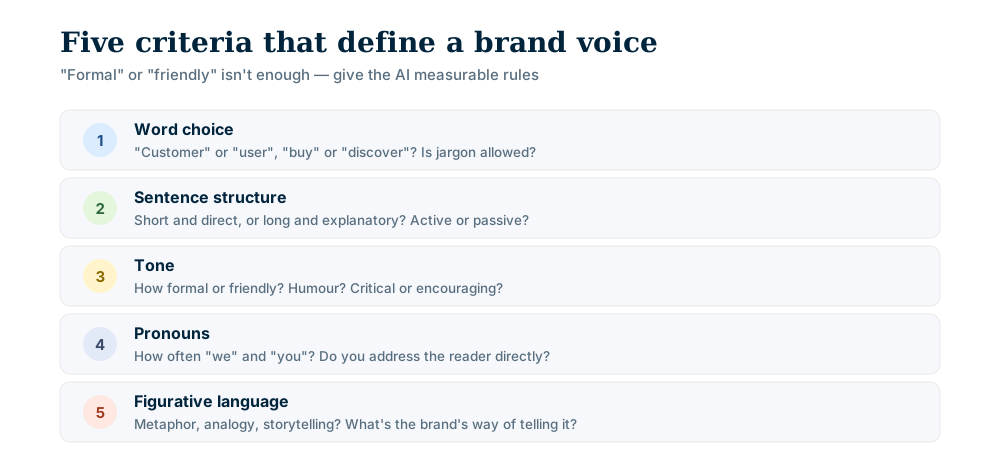
Typical signs of unguided AI text:
- Lack of specificity: General statements instead of concrete examples.
- Repetitive phrasing: The same transitions and sentence shapes again and again.
- Off-target tone: Too formal or too casual for your audience.
- Missing jargon: No product names or internal terms.
- Inconsistent voice: Style shifts within the same piece.
How do you define a brand voice for AI?
Write it as a short style guide the model can apply, with examples of what to do and what to avoid. Include:
- 1Tone descriptors: Pair each adjective with an example sentence, e.g. "direct but warm".
- 2Vocabulary: Terms to use and terms to avoid.
- 3Sentence structure: Preferred length, active versus passive voice, paragraph size.
- 4Audience: Who reads, what they struggle with, how they speak.
- 5Brand values: What the text should quietly reflect.
For a caption tool such as the Caption Generator, do not just give a product name. Specify the tone, the point of focus, the call to action and the words to avoid.
How do you keep AI content on brand?
Keep a human in the loop. Google's guidance on generative AI content says that using it to generate many pages without adding value for users may violate its spam policy on scaled content abuse. It also calls it critical to manually fact-check and review all AI-generated content before publishing, including titles, meta descriptions and image alt text (Google Search Central).
Why a human final say still matters
AI is a tool, not a replacement for judgment. An editor adds what a draft lacks:
- Nuance: Humor, empathy and cultural references.
- Accuracy: Models predict likely wording; they do not verify facts.
- Strategy: Fit with the wider marketing goal.
- Polish: Rhythm, cut filler, original detail.
| Feature | Unguided AI | Guided AI + human edit |
|---|---|---|
| Voice and tone | Generic, inconsistent | Distinct, consistent |
| Creativity | Formulaic | Fresh, specific |
| Accuracy | Variable, may contain errors | Fact-checked |
| Brand alignment | Low, heavy revision | High |
| Efficiency | Fast draft, slow cleanup | Fast draft, short cleanup |
Using AgentFabrica's management board, you can keep brand guidelines in one place and route every piece through a human check before publishing. The features page lists the rest.
write the voice down first
Output quality follows the brief. Define your voice in measurable rules, let AI speed up the draft and keep a person responsible for the final text. To put that workflow in place, see the pricing page or reach us through the contact page.
Bring content, scheduling and replies into one panel. Start with a free account; scheduling and images come with paid plans.