Contents
An ad funnel is the ordered path from seeing your ad to paying you. The steps differ by business: a store has cart and checkout, a clinic has enquiry and attendance, a software company has signup and first use. Force one template on all three and the dashboard reports steps that never existed.
Most ad dashboards assume one funnel: impression, click, add to cart, checkout, purchase. That is correct for an online store. The problem starts when the same funnel is applied to the dental clinic, the estate agency and the software company. A business that runs on appointments has no cart step. The dashboard shows zero and the diagnosis reports a low cart rate. Nothing dropped off; the thing being measured never existed in that business.
- Ad panels assume a single e-commerce funnel, but every sector's chain is different.
- The top steps are shared (impression, click); the lower steps change by sector.
- In a clinic the bottleneck is enquiry-to-confirmation, often caused by reply time; more budget will not fix it.
- In software, a user who signs up but never opens the product counts as a conversion yet earns nothing.
- The sector also changes which Meta event you read; the wrong funnel never reads the real conversion.
Is the Ad Funnel the Same for Every Business?
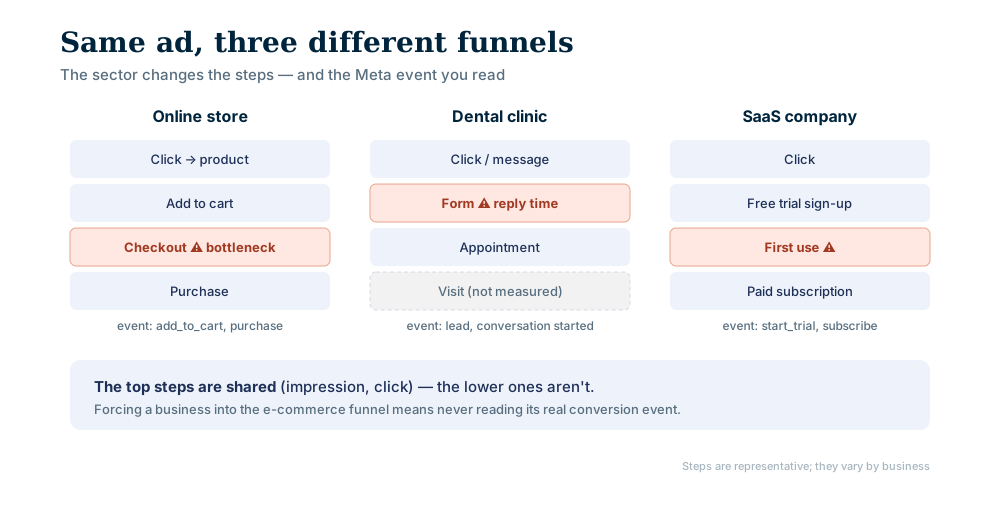
No. Impressions and clicks exist everywhere and mean the same thing. The lower steps depend on how the business sells. Put three businesses side by side and the difference is plain (the step names are illustrative):
| Business | Chain | Typical bottleneck | Meta event to read |
|---|---|---|---|
| Online store | Impression, click, product page, cart, checkout, purchase | Between cart and checkout | AddToCart, InitiateCheckout, Purchase |
| Dental clinic | Impression, click or message, form, confirmed appointment, attendance | Between enquiry and confirmation | Lead, or a messaging result |
| Software company | Impression, click, trial signup, first use, subscription | Between signup and first use | StartTrial, Subscribe |
The event names come from Meta's Pixel standard events reference. That list has no dedicated messaging event; the closest is Contact, described as a person reaching your business by phone, SMS, email or chat.
The Same Ad, Three Different Chains
Take three businesses spending the same budget on Meta.
Online store
Chain: impression, link click, product page, add to cart, checkout started, purchase. The bottleneck often sits between cart and checkout. Two common suspects are shipping cost appearing only at the last step and a forced account creation. These are hypotheses, not laws; walk through your own checkout step by step before you decide.
Dental clinic
Chain: impression, link click or message start, form or message, confirmed appointment, attendance. There is no purchase here. The bottleneck often sits between enquiry and confirmation, and a frequent cause is response time. Raising the ad budget widens that bottleneck rather than fixing it: more enquiries arrive, the same team answers at the same speed, and a larger share goes cold. We cover the speed side in our WhatsApp response time post.
The last two steps are also not digital. Confirmed appointments and attendance go unmeasured in most setups, so they never get credited to the advertising.
Software company
Chain: impression, click, free trial signup, first meaningful use inside the product, paid subscription. The bottleneck often sits between signup and first use. A user who signs up and never opens the product still counts as a conversion in the ad platform and produces no revenue, so a setup that watches signups alone rewards low-quality traffic. A different measurement error that inflates counts is covered in our post on tripled conversion counts.
How Does the Sector Change the Events You Read?
The event you read from Meta depends on the sector. Force a business into an e-commerce funnel and you never read its actual conversion event. The advertising may be working while the dashboard cannot see it.
This is why AgentFabrica's diagnosis engine does not run a single funnel. Each sector definition carries its own steps, its own Meta events and its own remedies. You can browse the industries we cover to see how the chains differ. When nothing matches, the engine does not fall back to e-commerce; it uses a sector-neutral funnel, because measuring less is more honest than measuring the wrong thing.
How Do You Draw Your Own Ad Funnel?
Whatever the dashboard says, write your chain down once. Three questions are enough.
- 1What steps does a customer pass through between first seeing you and paying you? Write the steps from real life, not from the dashboard: "saw us on Instagram, sent a message, asked the price, booked, came in, had the treatment, paid" (example).
- 2Which of those steps can be measured digitally? Usually the first three, rarely the rest. That is normal. What matters is knowing which ones are not measured.
- 3For the steps that cannot be measured, what will stand in for them? This is the question most often skipped and the most expensive to skip. Phone calls, walk-ins and field sales: ignore them and business lost at those steps is never credited to the advertising, so a working campaign looks bad.
The stand-in does not need to be sophisticated. A "how did you hear about us" question in the booking notes is the cheapest way to make an unmeasured step visible. It will not be perfect, and it beats nothing. Keep the chain current:
- Write the chain from real customer steps.
- Mark which steps have a digital event.
- Pick a stand-in for every step without one.
- Review the chain whenever your offer or booking process changes.
In Short
A funnel is not a template. It is a map of your business. Lay the template over the business and the real bottleneck never appears on the map, and a bottleneck you cannot see is one you will not fix. To run ad measurement that builds the right chain for your sector, see AgentFabrica's ad management features or pick a plan.
Bring content, scheduling and replies into one panel. Start with a free account; scheduling and images come with paid plans.