Contents
The Meta ads learning phase is the early period when a new ad set works out who to show your ad to. According to Meta's Help Center, an ad set stays in it until it collects enough results, a significant edit can restart it, and a set that cannot collect enough results is marked "learning limited". Cost during this window is not enough data to decide on.
When a new ad set goes live, Meta does not yet know who to show it to. It works that out by delivering: spreading budget across slices of your audience, watching who converts, then narrowing toward the slices that do. The details are on Meta's Help Center learning phase page.
The threshold most often quoted in the industry is about 50 results per optimisation event; we could not confirm that number on the official page, so the most reliable check is to watch when the "Learning" label disappears in your own account. The event in question is whatever the ad set was built to optimise for: purchases if it optimises for purchases, leads if it optimises for leads.
- A new ad set stays in the "learning phase" until it has enough results (the commonly quoted threshold is about 50 events).
- During this period cost can be high, but that number isn't enough data to decide on.
- Editing early (budget, targeting, creative) can restart the phase.
- Don't make performance decisions in the learning phase; only check the technical setup.
- A "learning limited" set is fixed by raising event volume, not by cutting the budget.
Two things are true at once during that window:
- Cost per result sits above the steady-state cost.
- That cost is not enough evidence to decide anything.
Holding both is uncomfortable, because the number on screen is real. What is not real is the assumption that it represents the future.
How Long Does the Meta Ads Learning Phase Last?
Duration depends on event volume, not on the calendar. With the same budget, one ad set can finish in a few days while another stays in learning for weeks. What separates them is how many optimisation events the set collects each week:
| Situation | What happens | What to do |
|---|---|---|
| High weekly event volume | The set finishes learning in a few days | Leave it alone |
| Volume is borderline | Learning drags on | Do not cut budget, raise event volume |
| Volume far below the threshold | The "learning limited" label appears | Consolidate sets, move the event up the funnel |
| Frequent edits | The counter keeps resetting | Stop intervening |
The Most Common Mistake
The campaign launches. Costs look high for two days. Someone cuts the budget or narrows the targeting.
If Meta treats that as a significant edit, it can restart the learning phase. You now pay for the expensive period again, this time on a smaller budget, which makes it slower and longer.
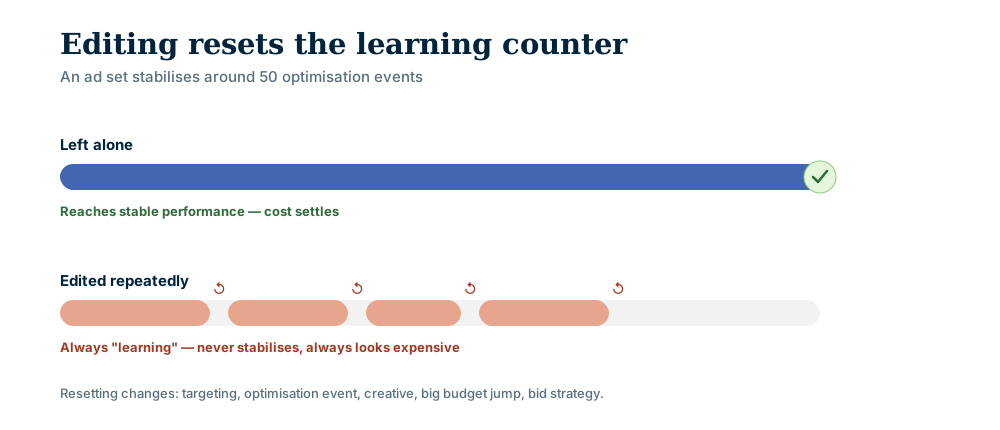
A campaign managed this way can sit in learning for weeks. Every intervention resets the counter, so it never reaches stable delivery and looks permanently expensive. The conclusion drawn is that the campaign is bad. In fact the campaign is a test that was never allowed to finish.
Which Edits Restart Learning?
Meta does not treat every change as significant. Broadly, changes that affect the delivery model reset the counter. The list below is common practice rather than an official list, so check the Help Center page for the full one:
- Targeting changes: audience, age, location, interests
- Changing the optimisation event
- Creative changes
- A large budget jump
- Bid strategy changes
A small copy fix or a modest budget increase usually will not reset it. The reliable way to know is to watch whether the "learning" label returns on the ad set. If it does, the counter went back to zero.
What Does "Learning Limited" Mean?
There is a second state, where an ad set never completes learning at all. Meta flags this as "learning limited", and it usually has one cause: weekly event volume is too low. The fix is not a smaller budget. It is more events:
- Consolidate ad sets. Budget split five ways is five half-finished learning phases. The same budget in one ad set has a chance of clearing the threshold.
- Move the optimisation event one rung up the funnel. An ad set with eight purchases a week cannot learn. The same ad set with sixty add-to-carts can. Once volume grows you can move the event back down to purchase.
- Stop over-narrowing. Three intersecting interests may not leave enough volume to learn on. Starting broad and letting the system narrow beats manual narrowing in most accounts.
- Check the attribution window. A short window leaves some real conversions uncounted, and an uncounted conversion contributes nothing to learning either. We explain the window difference in our attribution window post.
When Should You Decide?
The working rule: do not make performance decisions while an ad set is learning. That is not the same as ignoring it. Always check for technical faults, and fix them immediately:
- Does the link reach the right page?
- Is the pixel event firing?
- Was the ad approved, or is it stuck in review?
- Is the budget actually being spent?
Those are setup checks, not performance decisions, and they belong on day one. "This set is expensive, kill it" only means something once learning has finished.
AgentFabrica's ad assistant builds this rule into the engine. If the set is in learning, the diagnosis returns no performance verdict; it says to wait. Stopping the system from deciding early matters as much as stopping the person, because an automated rule makes the same mistake far faster.
After learning ends, stay careful: a large budget jump on a stable set can push it back into learning. Raise budgets in steps and give delivery a few days to settle after each one. Renew creative when frequency climbs and click-through starts falling, not when the calendar says so.
To tell whether a sale really came from the ad, read high ROAS but no profit. To apply this to your own account, check the pricing or write to us.
Bring content, scheduling and replies into one panel. Start with a free account; scheduling and images come with paid plans.