Contents
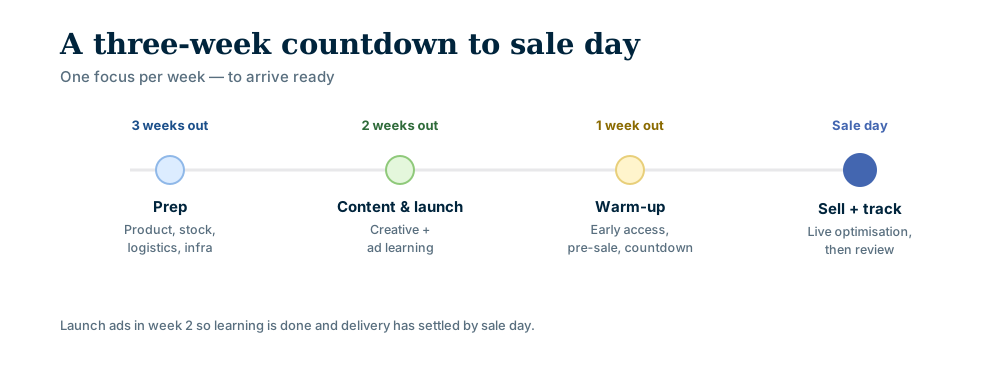
Start a seasonal campaign about three weeks before sale day: week three out for product, stock and logistics, week two for content and launching the ads, week one for warm-up and pre-sale. Three weeks is not an official rule but this guide's working rule, and the reasoning behind it is set out below.
Launching a few days before a big sale usually means going to market with thin stock, unfinished creative and ads that have not finished learning. A fixed countdown gives every step its own week, so nothing is rushed into the final days.
- A three-week countdown to sale day is the safest way to arrive ready for a seasonal campaign.
- 3 weeks out: product, stock, logistics and infrastructure prep.
- 2 weeks out: content and creative production, and launching ads so learning finishes in time.
- 1 week out: warm up with early access, pre-sale and a countdown.
- Sale day: live optimisation; afterwards, data analysis and next-season strategy.
How Far Ahead Should You Plan a Seasonal Campaign?
Three weeks, because three jobs have to happen in order: product and stock are ready first, content is produced next, and the ads learn last. Each depends on the one before. Giving each a week leaves a buffer inside every stage.
The number is a rule of thumb, not a measured value. A small catalogue with ready-made content may need only two weeks; a large store with complicated stock may need more. The one official anchor in this plan is the ad learning period (see week two). Check the exact date of the event each year from an official calendar and count backwards from it. Our holiday content calendar tool can help with the planning.
| When | Focus | Output |
|---|---|---|
| 3 weeks before sale | Product, stock, logistics, infrastructure | Campaign product list, counted stock, tested site |
| 2 weeks before sale | Content and launching the ads | Finished creative, live ads |
| 1 week before sale | Warm-up and pre-sale | Early access list, countdown |
| Sale day and after | Live tracking, then analysis | Optimised budget, season report |
Week 3: Product, Stock and Infrastructure
Three weeks out is the time for foundation work. Without the right products, enough inventory and a site that holds up, even the best ad strategy falls short.
- Product selection: Choose the products or services in the campaign. Update descriptions, photos and prices.
- Inventory check: Count stock for every featured product and set aside extra for a demand spike. This matters most for businesses with physical inventory.
- Logistics: Courier volumes rise around big events, so plan an alternative carrier or earlier dispatch.
- Site readiness: Test whether your site can handle campaign traffic, and check links, coupon codes and checkout.
Settle the last order date this week as well. Ask your carrier for its delivery time before the event and set a date you can promise customers (example: if delivery takes 5 working days, the last order date should be at least 5 working days before the event). That date goes into the ad copy and the site banner, so it has to be known before content is produced.
Week 2: Content, Creative and Launching the Ads
With products and concepts settled, week two finalises every asset and starts the ads.
- 1Finish the content: Complete ad copy, visuals, videos, landing pages and email sequences in one consistent brand voice.
- 2Set up the campaigns: Build the structure on your ad platforms, defining audiences, bidding and placements.
- 3Launch with enough budget: Let the platform gather data before sale day.
- 4Format for each platform: Short video for Reels and TikTok, a story for Facebook, a clear banner for the site.
When Should You Launch the Ads?
In week two, because of the learning period. Google Ads' Smart Bidding learning page says the learning period never lasts more than 7 days. The same page lists what triggers a "Learning" status: a new or re-enabled strategy, a change to the strategy mix and a change to the conversion goal. Budget, target and creative changes do not trigger it. Launch 14 days before sale day and you leave a week of buffer beyond the 7-day ceiling.
We could not verify an official day count for Meta, so we give no number. The logic is the same: give the algorithm time to collect data before sale day. Our post on not touching a campaign in learning explains why.
Week 1: Warm-Up and Pre-Sale
The last week builds momentum and prepares your audience for sale day.
- Early access: Offer loyal customers and your email list a pre-sale discount.
- Countdown: Use a timer on the site and social channels to create anticipation.
- Social engagement: Polls, live sessions and Q&A keep curiosity up.
- Customer service prep: Brief the team on the campaign and expect more messages.
Sale Day and After
On the day, the work is execution and real-time optimisation. Afterwards, evaluate the whole campaign.
| Stage | Focus | Key activities |
|---|---|---|
| Sale day | Live performance | Budget optimisation, conversion and click tracking, stock watch |
| After the campaign | Data analysis | Sales analysis, best product and channel, customer feedback |
Check the launch first, then watch conversion rate, cost per acquisition and return on ad spend. Once learning is over, pause weak ads and move budget to strong ones. When you read results, remember the 7-day versus 1-day attribution window; a one-day window can show fewer conversions than really happened.
In short: start early, keep a written plan for every stage, stay flexible and carry your measured data into next season. To plan and run campaigns from one panel, see AgentFabrica's performance ads features or check pricing.
Bring content, scheduling and replies into one panel. Start with a free account; scheduling and images come with paid plans.